

Types of MS
Multiple sclerosis (MS) affects each person differently. The three most common forms of MS are relapsing-remitting MS, secondary-progressive MS, and primary-progressive MS. In addition, other types of MS may be diagnosed, although these are far less common and some may be controversial or their definition may be evolving as more research becomes available.

Relapsing-Remitting MS
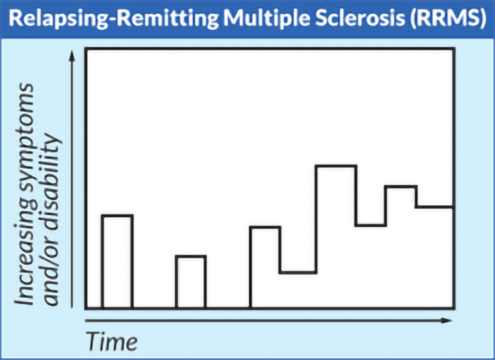
Initially, most people with MS experience symptom flare-ups, which are also known as relapses, exacerbations, or attacks. When individuals experience a relapse, they may be having new symptoms or an increase in existing symptoms. These usually persist for a short period of time (from a few days to a few months) and afterward may remain symptom-free for periods of months or years. This type of MS is referred to as relapsing-remitting MS (RRMS). Approximately 80 to 85% of individuals with MS are initially diagnosed with this form of the disease.
Secondary-Progressive MS
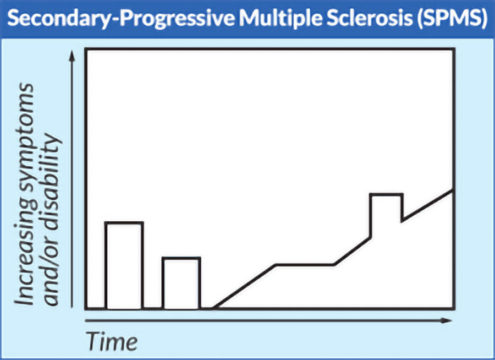
Over time, RRMS may advance to secondary-progressive MS (SPMS). This form of MS does not have the dramatic variations in symptoms that RRMS does, but rather has a slow, steady progression. Initially, people with secondary-progressive MS may still experience relapses, although these usually do not fully remit. This is referred to as “active” secondary-progressive MS. Without treatment, many of those with this form of MS eventually experience continued progression of disability without relapses, and this is referred to as “non-active” secondary-progressive MS.
Specifically, without treatment, approximately half of individuals with RRMS convert to SPMS within 10 years. However, with the introduction of disease-modifying therapies (DMTs) for MS, fewer individuals advance to this latter form of the disease.
Since 1993, more than 25 brand-name and generic DMTs have been FDA-approved and are available through prescription. Of these approved medications, all are approved for relapsing forms of MS (RMS), which includes secondary-progressive MS with relapses (active SPMS). Most of the treatments are also approved for clinically isolated syndrome (CIS); details on CIS are given later in this section.
Primary-Progressive MS
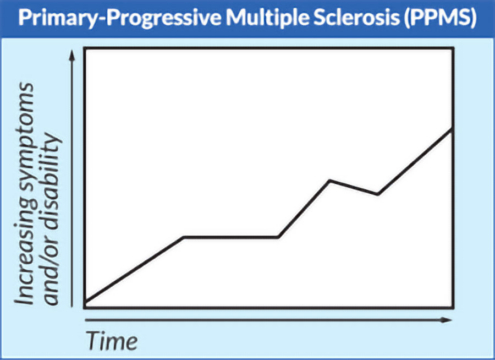
Approximately 10% of the MS population is diagnosed with primary-progressive MS (PPMS). Individuals with this form of MS experience a steady worsening of symptoms from the start, without periodic relapses and remissions. Currently, only one DMT is approved to treat PPMS.
Other Types of MS
While the majority of individuals with MS are initially diagnosed with one of the three main types of MS listed above, other types of MS do occur. These are far less common than the earlier three noted, and for some, such as “progressive-relapsing MS,” its definition and classification may change over time.
Young people under the age of 18 who are diagnosed with MS are referred to having “pediatric MS.” The vast majority (98 percent) of individuals with pediatric MS are diagnosed with the relapsing form of the disease. Only two DMTs are approved for the treatment of children and adolescents, ages 10 through 17, with relapsing forms of MS.
A small percentage of individuals are initially diagnosed with a less common form of MS known as progressive-relapsing MS (PRMS). This type of MS steadily worsens from the onset, but symptom flare-ups – with or without remissions – are also present. However, as the different forms of MS are further studied, redefined, and reclassified, the label of progressive-relapsing MS is being used less frequently. Other types of MS exist, but these are uncommon and different terminology may be used.
Prior to an MS diagnosis, individuals with “possible MS” may often fall under the parameters of one of two syndromes.
The first is clinically isolated syndrome (CIS), where someone may have experienced symptoms of MS for the first time, and an MRI may show evidence of MS, but a diagnosis cannot be confirmed at that time. Disease-modifying therapies are often used to treat CIS in an effort to delay or prevent the eventual diagnosis of MS.
The second syndrome is radiologically isolated syndrome (RIS), which is the term used when someone has an MRI performed for an unrelated reason, and shows evidence of MS on the MRI scan, but does not have any signs of MS symptoms. As with CIS, more evidence will be needed in the future to determine if someone with RIS may be diagnosed with MS.