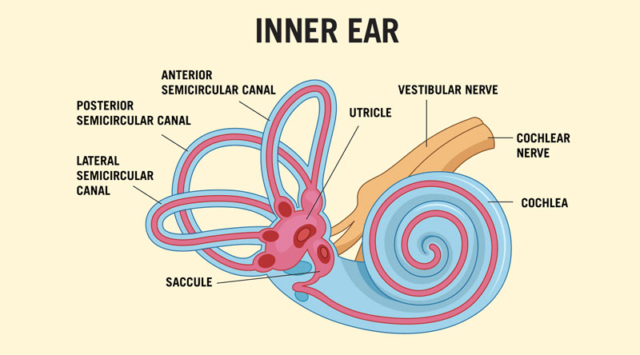
Peripheral pathology refers to disorders of the peripheral nervous system, involving the inner ear or vestibular nerve, and are frequently associated with vertigo, but are often benign and easier to treat.
These include:
- Benign paroxysmal positional vertigo (BPPV)
- Vestibular neuritis
- Vestibular migraine (VM)
- Ménière’s disease (MD)
- Cervical vertigo
Benign Paroxysmal Positional Vertigo
Benign paroxysmal positional vertigo (BPPV) is the most common cause of “positional vertigo,” which is when someone changes position – possibly lying back or sitting up – and experiences vertigo. It is also the most successfully treated type of vertigo. BBPV may also cause nausea, visual issues, and nystagmus.
The mechanisms behind BPPV are well-defined. Otoconia, also known as “ear stones,” are small calcium crystals found in two organs of your vestibular system called the saccule (sensitive to vertical acceleration) and the utricle (sensitive to horizontal acceleration); both are located in the inner ear. Hairlike cells within these organs are stimulated by the otoconia to tell the brain that the body is accelerating, which is a vital component to balance.3
Other important components to balance include three semicircular canals found in the inner ear region of both ears, and each is paired with the corresponding one on the opposite side. These canals are lined with cilia (microscopic hairs) and filled with a liquid substance, signaling the brain as to which direction the head is tilting. The three canals are anterior (detecting forward and back “nodding of head” movement), posterior (detecting a tilt-like head movement), and lateral (for side-to-side head movement).3
Through different positional testing, such as the “Dix-Hallpike” and “Roll” tests, doctors may determine which ear canal has been affected, and on which side, according to the movement of the eyes during these tests. Vertigo triggers and duration differ slightly between these canals as well. BPPV occurs when otoconia is dislodged from the utricle and enters one of the ear canals.
Age, head trauma, inner ear disease, vestibular neuronitis, osteoporosis, and inner ear surgery, are among the causes of otoconia becoming dislodged.2 With BBPV, when the head is moved, these misplaced calcium crystals improperly stimulate the cilia within the affected canal, sending false movement signals to the brain that are not in agreement with those signals from the corresponding canal, causing the individual to have the spinning sensation known as vertigo.
BPPV can be treated through different maneuvers performed by a doctor, while the patient is in lying and sitting positions, and having their head turned in certain directions. Examples of these maneuvers to reposition the calcium crystals include the “Epley maneuver,” the “Barbecue maneuver,” and the “Semont maneuver,” depending on which canal is affected.
According to an article on a holistic approach to dizziness, the authors note that treatments may be used for more severe symptoms of BBPV. They explain that antihistamines and anticholinergic drugs may be used to relieve nausea, vomiting, and vertigo during the acute phase of BBPV. Examples of these medications include dimenhydrinate, diphenhydramine, and metoclopramide. However, vestibular suppressants, which are medications used to suppress nystagmus (abnormal eye movement) and reduce motion sickness, cannot be used during treatment with one of the maneuvers mentioned previously; nor can these types of medicines be used for a prolonged period of time without the risk of developing chronic dizziness.2
Vestibular Neuritis
Vestibular neuritis is a disorder causing the vestibulocochlear nerve, which is located in the inner ear, to become inflamed. Thought to be caused by a viral infection, this affects balance and can cause dizziness and vertigo. Treatments for vestibular neuritis include medications such as antivirals and those used to treat nausea, dizziness, and inflammation. Physical therapy with specific exercises can also help reduce the symptoms.4
Vestibular Migraine
Vestibular migraine (VM) is a neurological condition and is the second most common cause of vertigo. Symptoms include sudden attacks of vertigo, along with migraine symptoms that are experienced with at least half of these attacks. Vestibular migraine symptoms include: headache; sensitivity to light, sound, and/or touch; nausea and vomiting; and migraine aura.
Treatments can include lifestyle changes to reduce stress and fatigue, watching for dietary sensitivities, and rehabilitation exercises to help with balance issues. Medications may be given to help prevent vestibular migraine, such as tricyclic antidepressants, calcium channel blockers, antiseizure medication, and beta-blockers. Nonsteroidal anti-inflammatory drugs (NSAIDs), motion-sickness medications, and antipsychotic medication may be used to help reduce the symptoms.5
Ménière’s Disease (MD)
Ménière’s disease (MD) is a rare disorder of the inner ear, affecting balance as well as hearing, and causing other symptoms such as vertigo and tinnitus (ringing in the ears). When someone is diagnosed with Ménière’s disease (MD), symptoms may come and go with this condition.6
MD cannot be cured, but treatments are available to help with symptoms. Treatments include vertigo medications and vestibular rehabilitation (exercises to help with balance). In more severe cases, middle-ear injections or surgery may be considered.7
Cervical Vertigo
Cervical vertigo is a condition where dizziness or vertigo (often more of a “floating sensation” versus spinning) is associated with neck pain. It may result from an injury to the neck, often occurring months or years earlier, or it may result from inflammation or arthritis within the cervical spine (neck) area. In addition to neck pain, dizziness, and a “floating” type of vertigo, symptoms can include balance problems and headache. Visual symptoms, such as rapid eye move-ment and visual fatigue, can also occur.
Cervical vertigo is treated by first addressing the problem causing neck pain, which might involve medications, physical therapy, and vestibular rehabilitation. Medications may include those that reduce inflammation and reduce dizziness, as well as muscle relaxants and pain relievers.8